
Is There Divinity Available in This Universe?

Humans are always searching for divinity everywhere, feeling that it is somewhere far away, perhaps in the sky, in a sacred place, or in another world. But divinity is not something that exists far from us. It is the very nature of everything that exists.
In Chivality, space itself is understood as divine. It is pure, endless, and untouched. The human mind arises from the same source. Yet it is not experienced as divine because it is mixed with thoughts, desires, and emotions.
When these reduce through Silentation and remembrance of the Master, the mind becomes quiet. When it becomes completely still, what remains is Chivam, the original state of divinity.
Divinity is already present as space, silence, and stillness within us. We do not notice it because the mind is constantly active. When the mind becomes silent, even for a short time, divinity is not seen as something separate to achieve. Instead, it is felt as our own natural state. Even though divinity is always present, it reveals itself in three levels.
Brahmam — Divinity as Pure Mind
Brahmam, the first level, is when the mind becomes calm and purified as negative thoughts fade away. Even when thoughts arise, they are positive and non-disturbing. A person feels calm, happy, and balanced. Here, the person feels: “I am experiencing peace or divinity.” Therefore, there is still a sense of “I” experiencing peace. This means duality remains. Brahmam is a clean and peaceful state of mind, where divinity is reflected through the mind.
Parabrahmam — Divinity as Pure Intellect
Parabrahmam is the next stage, where the shift deepens from mind to intellect. At this level, even positive thoughts are not necessary. There is a quiet understanding that arises without thinking. The person can clearly perceive what is right and wrong, without confusion or emotional disturbance. A subtle sense of “I” still remains, but it is very light. Divinity at this stage is not experienced as peace or happiness, but as clarity and simple knowing. Here, the mind is no longer active, yet the identity has not fully disappeared.
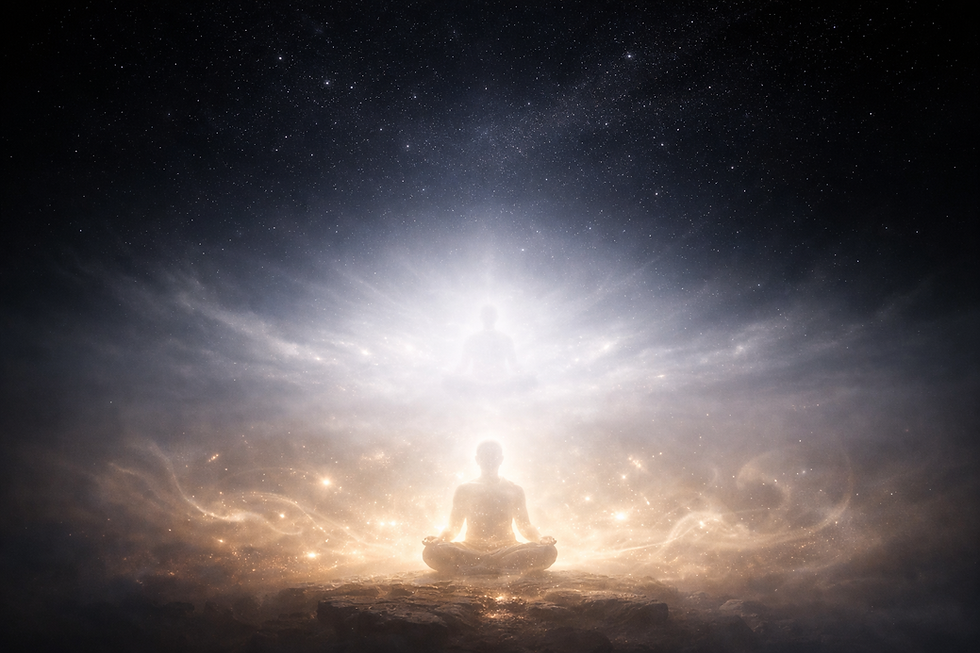
Chivam — The Supreme (Beyond Experience)
Chivam is the final level, which cannot be explained in ordinary terms. Here, there is no mind, no intellect, and no experiencer. Because of this, there is no experience of divinity.
Experience needs two things: someone who experiences and something that is experienced. In Chivam, this division is not there.
What really happens is that the one who was experiencing disappears. The sense of “I” comes to an end. It is not that a person becomes Chivam. It is that the person as an identity, is no longer present. Because of this, Chivam cannot be seen, imagined, or experienced. Seeing requires a seer. Thinking requires a mind. Experience requires an experiencer. In this state, none of these are present.
So, the most important understanding is this: when the identity of the experiencer is gone, that itself is called Chivam. It is not a change from one state to another, but the ending of the sense of being separate.
These three levels unfold naturally. First, the mind becomes calm and pure. Then even thinking subsides. Finally, the sense of “I” dissolves.
Silentation plays an important role in this process. It helps to reduce the mental noise, which leads to the first level. With deeper practice and the support of the Master’s energy, even the intellect becomes quiet, leading to the second level. When stillness becomes complete and effortless, the experiencer itself disappears, and what remains is Chivam.
In the end, Brahmam can be experienced through the mind. Parabrahmam can be understood without mind, using Buddhi. But Chivam cannot be experienced or known, because there is no one left to experience or know it.


Namah Chivaya